
A Childhood Marked by Loss
Excerpts from the memoirs of C. S. Smith (Smilgjus)

When you read Stan Smith’s memoirs, what stands out isn’t drama—it’s how plainly he tells things. He doesn’t try to shape the story into something bigger than it is. He just remembers. And in that, you start to get a real sense of the world he grew up in.
It wasn’t an easy place to be a child. Families were large, homes were tight, and illness was never far away. In places like the Gorbals, people didn’t talk about hardship as something unusual—it was simply part of life.
A Mother’s Strength
“Mother: Julia… Bearing six children and living in a poor environment soon took its toll. She had bronchitis and developed asthma, dying at the early age of fifty-six.
I miss her dearly and have fond memories of her love for her children, giving fully of herself to her family.” (p.4)
There’s something steady and respectful in the way Stan writes about his mother. He doesn’t dwell on the hardship—but you can feel it there. You get the sense of a woman who gave what she had, and a son who never forgot it.
The First Loss: Adele

“I was a very small child when Adele was taken to hospital as a tiny babe… no one was allowed any contact… Adele’s condition had not improved and shortly after she passed on.
I asked my mother, ‘Where has she gone?’ Mother’s reply, ‘The white doves have come and carried her off to heaven.’” (p.5)
That answer—gentle, but incomplete—stays with him. And like many children, he tries to make sense of it in his own way:
“I pondered on the method of transport… one or two doves would get to either side of Adele… and fly away, up into the sky. I was glad for Adele, for now she was in heaven and not sick any more.” (p.5)
There’s a quiet kindness in that thought. It doesn’t erase the loss, but it softens it just enough for a child to carry.
A Sudden Tragedy: Alice
[Image Suggestion]
Interior of a tenement kitchen with stove and wash basin (historical photo)
Caption: Daily routines in tenement homes often involved open heat sources and manually heated water.
“One day I was playing on the stairway… I heard some screaming… Mother dashed over to the neighbour’s…
…She was in the process of getting the cold water when Alice, who loved her bath, climbed into the bath of boiling hot water.” (p.6)
It’s hard to read, even now. And what makes it more powerful is that Stan doesn’t linger on it—he just tells it as it happened.
“Alice was rushed to the hospital but died later that evening. Mother was in shock and her grief was such that I am sure it was the turning point in her general health.” (p.6)
Loss Builds on Loss
“From that time forward, we all rallied around her… The last time I saw Mother… she said, ‘I shall never see you again.’ She was right… She passed on the following year.” (pp.6–7)
There’s no attempt to dramatize this moment. And that’s exactly why it stays with you. It feels real—like something remembered rather than retold.
Looking Back
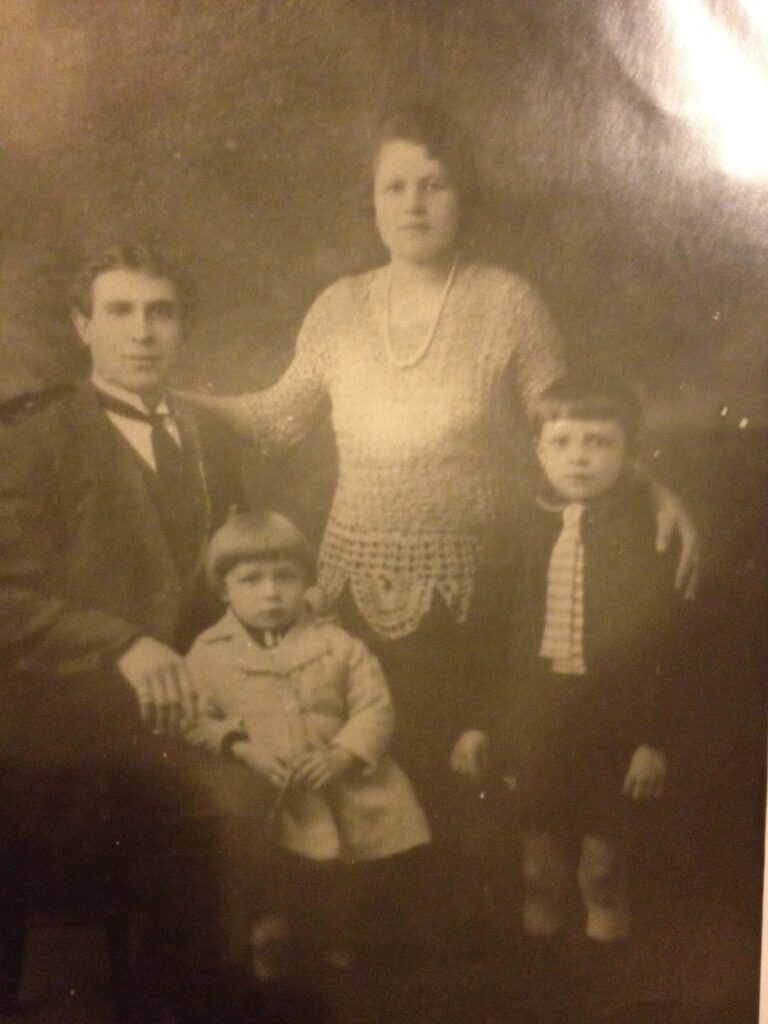
Reading Stan’s words today, it’s easy to place them in a larger history—of Glasgow, of working-class life, of a time when childhood illness and loss were far more common than they are now.
But for Stan, it doesn’t feel like history. It feels like memory.
This story is drawn from the memoirs of C. S. Smith, preserved by the Smith family. Excerpts are reproduced to maintain the author’s original voice and intent.
Smith Family Roots Ancestors
- Adele Smilgjus (1920 – 1921)
- Alice Smilgjus (1928 – 1930)
- Constantinas Smilgjus (1919 – 2007)
- Felix Smilgjus (1917 – 1962)
- Ipolitas (Felix) Smilgjus (1891 – 1974)
- Julijona (Julia) Butanavicjute (1897 – 1953)